
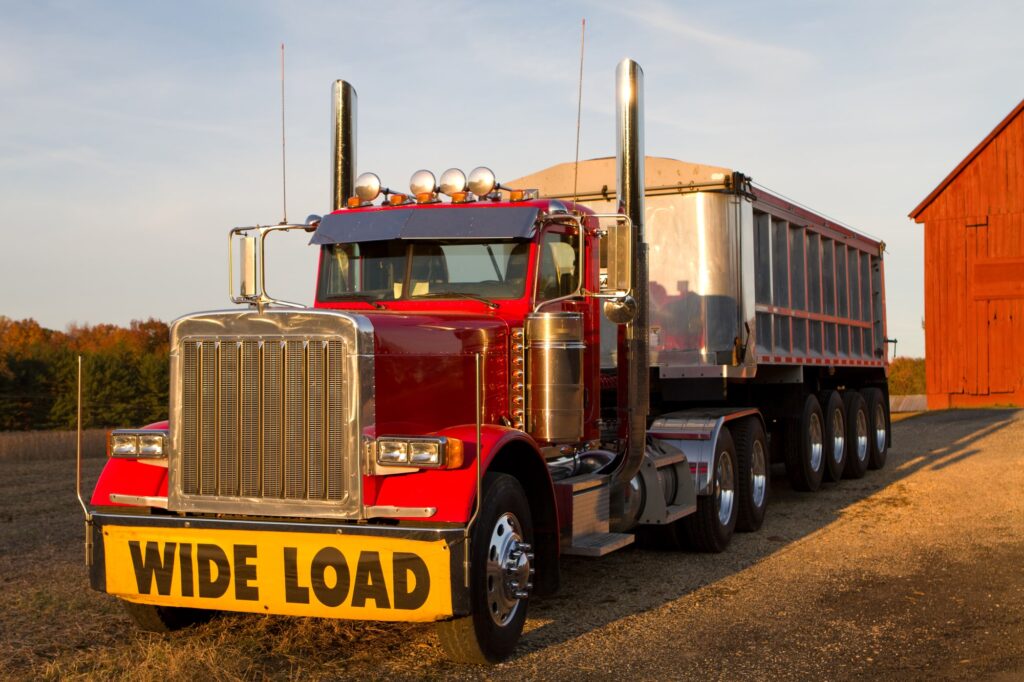
Truck Accident Lawyer Raleigh, NC
If you have been injured in a collision with a commercial truck in Raleigh, you are likely facing injuries more serious than those from an ordinary car accident, accumulating medical expenses, and a defense already under construction by the trucking company’s insurer. Commercial carriers typically have rapid response investigators on scene within hours, and what they secure often shapes the outcome of the claim.
Burton Law Firm represents clients injured by commercial vehicles throughout Wake County. Attorney Jason Burton has 13 years of experience in catastrophic injury and motor vehicle matters and has recovered millions of dollars for personal injury clients in North Carolina and Virginia. We know how commercial carriers defend these cases, how federal motor carrier regulations apply, and what evidence must be preserved before it disappears.
Our Raleigh, NC truck accident lawyer handles these matters on contingency. No fees are owed unless we recover on your behalf.
Why Choose Burton Law Firm for Truck Accidents in Raleigh, NC?
Commercial truck cases differ significantly from passenger vehicle collisions. Liability can extend beyond the driver to the trucking company, cargo loader, maintenance contractor, and equipment manufacturer. Identifying the right defendants and building a case against each requires specialized attention.
Knowledge of Commercial Trucking Law
Attorney Jason Burton has practiced plaintiff-side injury law since 2013. He is licensed in North Carolina and Virginia and is a summa cum laude, valedictorian graduate of Elon University School of Law, where he serves on the Advisory Board. Mr. Burton maintains an Avvo rating of 10.0 and has been recognized by the National Academy of Personal Injury Attorneys as one of the Top 10 Personal Injury Attorneys Under 40.
Our personal injury lawyer in Raleigh, NC focuses on catastrophic injury, motor vehicle, and wrongful death matters.
A Record of Substantial Recoveries
Our firm has obtained millions of dollars on behalf of clients in motor vehicle and catastrophic injury matters, including seven-figure and multiple six-figure truck accident recoveries.
Early Evidence Preservation
Commercial carriers must maintain certain records for limited periods. Driver logs, electronic control module data, maintenance records, and dispatch communications can be lost or overwritten if not preserved quickly. We issue spoliation letters immediately on intake and engage reconstructionists when the physical evidence warrants it.
Contingency Representation
You pay nothing at the outset. Our fee is calculated as a percentage of the recovery and applies only if we recover. Consultations are provided at no charge.
Candid Case Evaluation
Not every collision warrants protracted litigation. We provide an honest assessment of case value, identify the issues likely to be contested, and advise whether a carrier’s offer falls within the reasonable range for comparable matters.
Client Feedback
⭐⭐⭐⭐⭐
“I can’t thank Jason Burton and his exceptional team enough for the incredible support and dedication they provided to my family during our legal journey. From the moment we reached out, Jason’s professionalism and expertise were evident. His team went above and beyond, surpassing our expectations at every step.” – Jane Smith
Additional reviews are available on our Google Business Profile.

Types of Truck Accident Cases We Handle in Raleigh
Commercial vehicle collisions arise in a variety of configurations. The type of truck, cargo, and operation involved shape both the proof required and the parties who may be liable. Our firm handles the following categories of truck accident matters in Wake County.
- Tractor-trailer collisions. Eighteen-wheelers operating on I-40, I-85, I-95, and US-1 produce the largest share of serious commercial vehicle claims, and these cases almost always involve federal motor carrier safety regulations alongside state law.
- Rear-end collisions. A fully loaded tractor-trailer requires substantially more stopping distance than a passenger vehicle, and following too closely or distracted driving produces catastrophic rear-end collisions when traffic slows or stops suddenly.
- Jackknife accidents. Aggressive braking on wet pavement, brake imbalance between the tractor and trailer, and abrupt steering input cause the trailer to swing out of alignment with the tractor, sweeping across multiple lanes of traffic and striking surrounding vehicles.
- Rollover accidents. Excessive entry speed into curves and interchange ramps, unbalanced or shifting cargo, and liquid surge in partially filled tankers cause commercial vehicles to overturn and come to rest on their side or roof.
- Underride and override collisions. When a passenger vehicle slides under the trailer or a truck rides up over a smaller vehicle, the resulting injuries are typically severe or fatal, and federal rear-guard regulations may provide additional recovery avenues.
- Cargo-related crashes. Improperly secured or overloaded cargo can shift during transit, cause loss of control, or fall from the trailer, and liability for these common causes of truck accidents may extend to the shipper, loader, or broker in addition to the carrier.
- Hazardous materials accidents. Spills and fires involving tanker trucks produce exposure injuries, burn injuries, and secondary collisions, and these cases implicate both federal hazmat regulations and environmental agencies.
- Delivery truck accidents. Straight trucks, delivery vans, and refrigerated trucks operated by regional carriers are increasingly common in Raleigh traffic, and claims against these operators involve many of the same considerations as tractor-trailer cases.
- Impaired driver accidents. Hours-of-service violations and driver impairment support both liability and, in appropriate matters, punitive damages, and these facts often emerge only through careful review of driver logs and carrier records. Similar patterns arise in DUI accident cases involving any motor vehicle.
- Faulty equipment and maintenance crashes. Brake failures, tire blowouts, and steering defects can shift liability to maintenance contractors or equipment manufacturers, and federal inspection records are central to proving the defect.
- Motorcycle collisions with trucks. Riders struck by commercial vehicles sustain some of the most serious injuries we see, and these cases often combine truck investigation with motorcycle accident representation.
- Fatal accidents. When a commercial vehicle crash results in death, we represent surviving family members in wrongful death claims, where the personal representative of the estate brings the action and the proof requirements differ from ordinary survival actions.
North Carolina Legal Requirements for Truck Accidents
Commercial vehicle claims in North Carolina involve both state injury law and a substantial overlay of federal regulation. Several provisions warrant early attention.
Statute of limitations. Under N.C. Gen. Stat. § 1-52, an injured party generally has three years from the date of the collision to file a personal injury action. Wrongful death claims carry a two-year deadline under § 1-53. The official text of these provisions is available through the North Carolina General Assembly.
Federal Motor Carrier Safety Regulations. Interstate carriers and their drivers are subject to the Federal Motor Carrier Safety Regulations administered by the FMCSA. These rules govern driver qualifications, hours of service, vehicle maintenance, drug and alcohol testing, and carrier recordkeeping, and we address the role of federal trucking regulations in individual cases throughout our practice. Violations frequently support liability and sometimes establish negligence per se.
Hours-of-service rules. Federal hours-of-service regulations limit the time a commercial driver may operate a vehicle without rest. Violations are a common factor in fatigue-related crashes and can be proven through electronic logging device data and carrier records.
North Carolina motor carrier requirements. Intrastate carriers operating only within North Carolina are subject to rules administered by the North Carolina Department of Public Safety through its Motor Carrier Enforcement section, which adopts most FMCSA provisions with some state modifications.
Pure contributory negligence. North Carolina applies pure contributory negligence, a doctrine that bars recovery if the injured party bears any portion of fault. In truck cases, defense counsel routinely attempt to shift some fault onto the injured motorist, and the claim file must be built to foreclose those arguments.
Insurance coverage requirements. Commercial motor carriers must carry minimum liability coverage substantially greater than the 30/60/25 minimum for passenger vehicles. Federal minimums for general freight carriers begin at $750,000 and rise for hazardous materials transport.
What Damages Are Recoverable in Raleigh Truck Accident Cases?
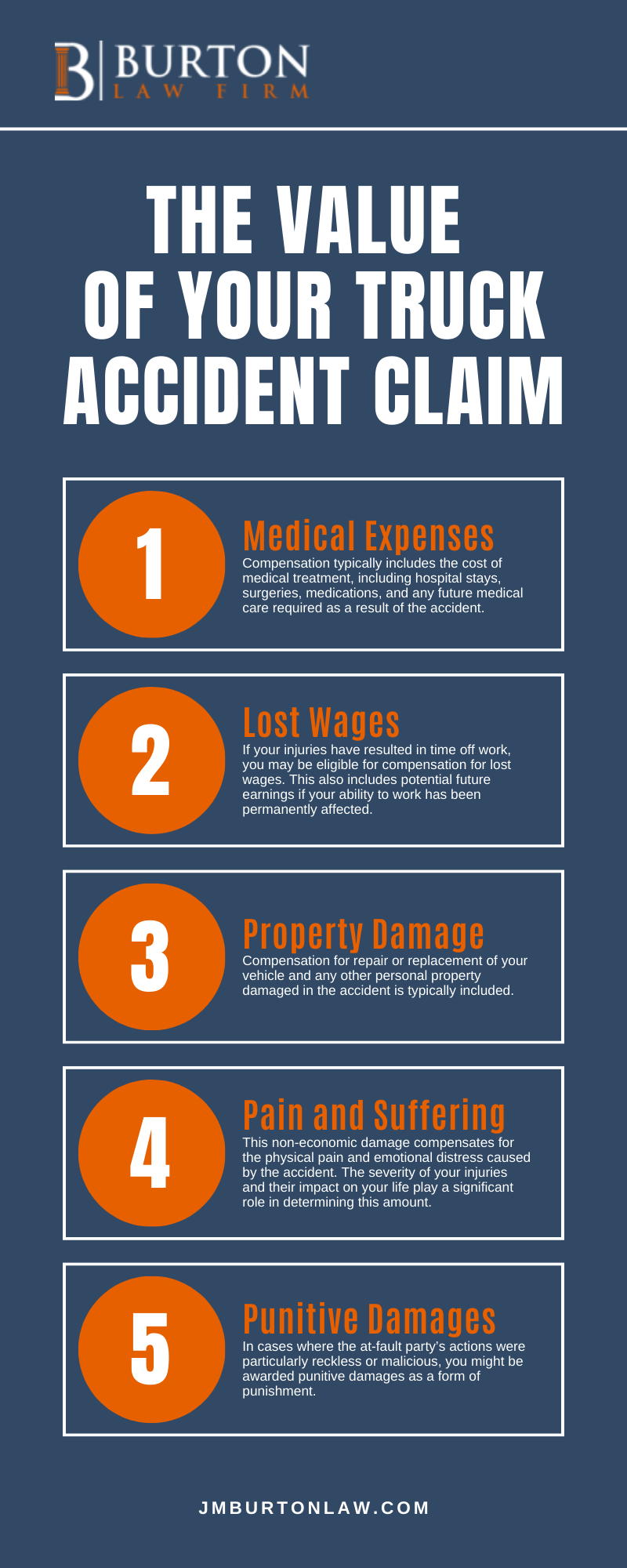
North Carolina law recognizes three principal categories of damages available to a truck accident victim. The magnitude of commercial vehicle injuries often pushes each category to higher values than ordinary auto cases.
Economic Damages
Economic damages are those capable of documentation and calculation. They often extend across many years in serious truck cases.
- Past and future medical expenses, including emergency services, surgical care, rehabilitation, imaging, pharmaceuticals, and durable medical equipment for injuries ranging from fractures to traumatic brain injuries and spinal cord damage
- Lost wages and diminished earning capacity, including the need for vocational retraining when return to prior employment is not feasible
- Property damage to the vehicle and its contents
- Home modifications, assistive devices, and attendant care in cases involving permanent impairment
- Life care plan implementation costs where long-term medical and support needs are documented, particularly in spinal cord injury cases that require ongoing attendant care
Non-Economic Damages
Non-economic damages compensate harms that resist precise calculation and often represent a substantial portion of a serious truck accident recovery.
- Physical pain and suffering
- Permanent disfigurement and scarring
- Loss of enjoyment of life
- Emotional distress, anxiety, and post-traumatic stress
- Loss of consortium, which belongs to a spouse and addresses the effect of the injuries on the marital relationship
Insurance adjusters routinely price non-economic damages as low as the facts permit, particularly in cases involving catastrophic truck injuries that will affect the claimant for years. We substantiate these categories through medical records, treating provider testimony, psychological evaluation, and day-in-the-life documentation.
Punitive Damages
Under N.C. Gen. Stat. § 1D-15, a jury may award punitive damages when the defendant’s conduct was willful or wanton. Driver impairment, falsified logs, knowing dispatch of unfit drivers, and reckless operation of heavy equipment may all support such awards. Punitive damages are capped at three times compensatory damages or $250,000, whichever is greater. The applicable statutes are available through the North Carolina punitive damages chapter.
Wrongful Death Damages
When a truck crash results in death, the estate may recover funeral and medical expenses, lost net income, and the value of the decedent’s care, companionship, and guidance under N.C. Gen. Stat. § 28A-18-2. The personal representative of the estate brings the claim.
What Steps Should I Take After a Truck Accident?
The following ten steps, taken in the immediate aftermath of a commercial vehicle collision, protect both your health and the integrity of any subsequent claim. Evidence in truck cases degrades faster than in ordinary auto cases because of the defense apparatus that responds.
- Move to a position of safety if possible. If movement will not aggravate injuries, relocate away from the roadway. Secondary collisions at truck crash scenes are a documented risk.
- Contact 911. Request emergency medical services and law enforcement. The North Carolina State Highway Patrol typically investigates commercial vehicle crashes on interstates and state highways, and the resulting report is foundational evidence.
- Accept medical evaluation at the scene. Adrenaline often masks the symptoms of serious trauma. Spinal, internal, and head injuries frequently do not manifest for hours.
- Limit statements to factual observations. Any statement made at the scene may be admissible later. Avoid speculation about fault, speed, or what happened.
- Photograph the scene thoroughly. Document the vehicles, skid marks, debris fields, cargo, placards, DOT numbers, and roadway conditions. The DOT number identifies the motor carrier and is essential to the investigation.
- Identify the driver and the carrier. Record the driver’s name, commercial driver’s license number, the tractor and trailer numbers, the carrier’s name, and the carrier’s DOT and MC numbers if visible.
- Obtain witness information. Secure contact information from every witness at the scene. Commercial carrier investigators arrive quickly and will collect the same information for the defense.
- Seek prompt medical follow-up. An emergency department or urgent care visit on the day of the crash, followed by primary care within the week, establishes the medical record. Treatment gaps are regularly exploited by carrier-retained defense counsel.
- Do not communicate with the carrier’s insurer without counsel. Commercial liability insurers deploy experienced adjusters to truck cases immediately. Statements made to them can reduce or defeat the claim.
- Consult a truck accident lawyer promptly. The first 72 hours after a commercial vehicle crash are critical to evidence preservation.
Raleigh Truck Accident Infographic
Truck Accident Statistics in Raleigh
Large truck crashes remain a significant source of serious injury and death in North Carolina. The underlying data shapes how these cases are investigated and valued.
According to the Federal Motor Carrier Safety Administration, large trucks are involved in thousands of fatal and injury crashes each year, with most fatalities occurring among occupants of passenger vehicles rather than truck drivers.
The National Highway Traffic Safety Administration tracks crash and fatality data for large trucks separately, and its analyses identify driver fatigue, excessive speed, improper maneuvers, and alcohol involvement as leading contributing factors.
In North Carolina, the NCDOT Highway Safety Program compiles annual crash statistics that include commercial vehicle involvement, and the NCDOT crash data tool allows review of county-level patterns.
Wake County, with a population exceeding 1.1 million and traffic on I-40, I-85, I-95, I-440, I-540, and US-1, experiences a meaningful share of the state’s commercial vehicle collisions. The concentration of distribution, logistics, and retail operations in the Raleigh area produces steady tractor-trailer traffic through Wake County at all hours.
The Insurance Institute for Highway Safety notes that passenger vehicle occupants account for most deaths in large truck crashes, reflecting the disparity in size and weight between commercial vehicles and the cars they strike.
Defense counsel sometimes invoke broad statistics about truck driver training to argue that their driver or carrier behaved reasonably. The specific facts of each crash, documented through carrier records, electronic logging data, and reconstruction, determine the actual outcome of the individual case.
Raleigh Truck Accident Lawyer FAQs
How much does it cost to hire a Raleigh truck accident lawyer?
Nothing at the outset. Our firm handles truck accident cases on contingency. The fee is calculated as a percentage of the recovery and is payable only if a recovery is obtained.
How long do I have to file a truck accident claim in North Carolina?
Three years from the date of the crash for personal injury under N.C. Gen. Stat. § 1-52. Two years for wrongful death. Claims against government entities carry substantially shorter notice requirements.
What makes truck cases different from car accident cases?
Several features distinguish commercial vehicle cases from ordinary car accident claims. The injuries are typically more severe. Multiple defendants may share liability. Federal motor carrier regulations apply alongside state law. And the defense response begins within hours of the crash rather than days or weeks.
Who can be held liable in a truck accident case?
Potential defendants include the driver, the motor carrier, the vehicle owner if different from the carrier, the cargo loader or shipper, the maintenance contractor, and the equipment or parts manufacturer. The correct analysis depends on the specific facts.
What evidence is unique to truck cases?
Driver logs, electronic logging device data, electronic control module data, dispatch communications, maintenance and inspection records, drug and alcohol testing records, driver qualification files, and any onboard camera footage. Black box data from the engine control module is particularly valuable because it records speed, braking, and steering input in the seconds before impact. Each of these categories has a retention period, and some are subject to overwrite or destruction within weeks.
What is a spoliation letter?
A spoliation letter is a formal notice to the carrier and other potentially liable parties demanding the preservation of specific categories of evidence. Sending such letters immediately after a crash is one of the most important early steps in a truck case.
The trucking company’s insurer called me. Should I give a statement?
No. Recorded statements to the carrier’s insurer can be used to reduce or defeat the claim, and there are specific reasons not to speak with the trucking company’s insurance adjuster without counsel present. Clients should consult an attorney before any such communication.
The carrier offered a quick settlement. Should I accept?
Early offers almost always undervalue serious commercial vehicle injuries, which often develop over time and may require surgical intervention or long-term care. Once a release is signed, the claim is closed.
What if the truck was an independent contractor?
Carriers sometimes attempt to shield themselves from liability by classifying drivers as independent contractors. Federal and state law impose limits on that defense, and in most cases the injured motorist can still sue both the truck driver and the trucking company under vicarious liability and the statutory employee doctrine.
How are damages valued in a truck case?
Damages are assessed based on medical treatment, permanency of injury, effect on earning capacity, and the quality of non-economic proof. Larger insurance limits on commercial policies typically correspond to higher case values.
How long does a truck accident case take?
Cases with clear liability and limited injuries may resolve in several months. Cases involving surgery, disputed liability, or litigation commonly require one to three years. We do not pursue premature settlements that undervalue the claim.
What if the driver crossed state lines?
Most commercial trucks are engaged in interstate commerce and fall under federal motor carrier rules. The case itself remains subject to North Carolina substantive law if the crash occurred here, but federal regulations inform the duty of care.
Can I recover lost wages if I am self-employed?
Yes, with appropriate documentation. Tax returns, 1099 forms, profit-and-loss statements, and executed contracts all support proof of lost income.
Will my case go to trial?
Most truck matters resolve through negotiation or mediation. Some proceed to trial. Mr. Burton is a trial lawyer, and that capability factors into carrier evaluations of our files.### What should I bring to an initial consultation?
The crash report, photographs, any medical records you have received, correspondence with insurers, the names of treating providers, and any information you recall about the driver, the truck, and the carrier. Clients lacking any of these items should still schedule a consultation. Our firm assists with record gathering.
Most Dangerous Locations for Truck Accidents in Raleigh
Certain corridors in and around Raleigh produce disproportionate numbers of commercial vehicle crashes because of traffic volume, interchange design, and freight activity.
- Interstate 40 through Wake County. A primary east-west freight route with continuous truck traffic and a documented history of serious commercial vehicle crashes, particularly near the I-440 and US-1 interchanges.
- Interstate 85 corridor. Heavy interstate freight movement and significant volume of tractor-trailer traffic between the Triangle and points north and south.
- Interstate 95 east of Raleigh. A major north-south freight artery with heavy truck traffic, particularly near Smithfield and Kenly, where multi-vehicle commercial crashes have occurred.
- Interstate 440 (Beltline). Congested commuter route with commercial vehicle traffic merging and exiting at short-distance interchanges.
- Interstate 540. Speed-related commercial vehicle incidents and merge-zone collisions.
- US-1. Mixed commercial and passenger vehicle traffic through Raleigh and Cary.
- US-70. Substantial truck movement serving regional distribution operations.
- Capital Boulevard. High-volume urban corridor with delivery vehicle traffic and frequent intersection collisions.
Our firm has handled commercial vehicle cases on substantially all of these corridors.
What Are Important Local Resources for Raleigh + Truck Accident?
The resources below may be of assistance following a commercial vehicle collision in the Raleigh area. Burton Law Firm is not affiliated with any of these organizations, and inclusion is not an endorsement.
- North Carolina State Highway Patrol. Troop C main line: (919) 733-7952. Investigates commercial vehicle crashes on interstates and state highways.
- Raleigh Police Department. Main line: (919) 996-3335. Handles non-emergency reporting within city limits.
- Wake County Sheriff’s Office. Main line: (919) 856-6900. Responds to crashes in unincorporated areas of Wake County.
- WakeMed Trauma Center. Main line: (919) 350-8000. Level I trauma facility and a primary destination for severe truck crash injuries.
- UNC REX Healthcare. Main line: (919) 784-3100. Major Raleigh hospital system.
- FMCSA Safety Measurement System. Online portal for reviewing federal safety and compliance data on specific motor carriers.
- NCDOT Crash Reports. Portal for ordering official crash report copies.
Contact Burton Law Firm
Commercial vehicle cases move quickly in the first days after a crash. Driver logs, dispatch records, and inspection files can be lost before most injured motorists are discharged from the hospital. Insurance carriers begin building a defense within hours.
Burton Law Firm accepts Raleigh truck accident cases on contingency. No fees are owed unless a recovery is obtained. The initial consultation is provided at no charge.
Contact us to discuss your truck accident case with our firm.
Visit Our Raleigh Truck Accident Lawyers.
219 N Boylan Ave 1st Floor, Raleigh, NC 27603