
Rear End Collision Lawyer Raleigh, NC
If you have been struck from behind by another vehicle on I-440, Capital Boulevard, or another Raleigh roadway, you may be dealing with neck and back pain, a totaled or damaged vehicle, missed time at work, and ongoing communication from the other driver’s insurance carrier. Burton Law Firm has represented injury victims throughout Wake County since 2012. Our founding attorney, Jason M. Burton, is a fifth-generation trial lawyer with substantial experience handling catastrophic injury and motor vehicle litigation, and he applies a detailed working knowledge of how insurance carriers evaluate rear impact claims on behalf of the clients he now represents. Clients seeking a Raleigh, NC rear end collision lawyer following a serious crash are invited to contact our firm to discuss available legal options.
Why Choose Burton Law Firm for Rear End Collision Cases in Raleigh, NC?
Selecting qualified legal representation is among the most consequential decisions a crash victim will make. Insurance carriers routinely assess the strength of a claim based in part on the reputation of opposing counsel, and that assessment influences settlement valuations well before any formal demand is submitted.
Substantial Experience in North Carolina Motor Vehicle Litigation
Jason M. Burton has concentrated his practice on personal injury matters for more than 13 years, with a substantial portion of that work devoted to motor vehicle collision cases. He is admitted to practice in both North Carolina and Virginia. Mr. Burton earned his Juris Doctor from Elon University School of Law, graduating as valedictorian and summa cum laude, and served on both the Elon Law Review and the Moot Court Board. He currently serves as an Advisory Board Member at the law school.
Our car accident lawyer in Raleigh, NC is the son of a career long insurance defense attorney and maintains a thorough understanding of how carriers evaluate rear impact injury claims, including the common defense arguments advanced with respect to causation, preexisting conditions, and alleged minor impact soft tissue injury.
Documented Results in Serious Injury Matters
Mr. Burton holds Life Memberships in both the Million Dollar Advocates Forum and the Multi-Million Dollar Advocates Forum, distinctions requiring verified settlements or verdicts at specified recovery thresholds. Our firm has recovered millions of dollars for clients across motor vehicle, premises liability, and wrongful death matters.
Additional professional recognitions include:
- North Carolina Super Lawyers Rising Star designation (2017 through 2019)
- National Trial Lawyers Top 10 Under 40 (2019)
- National Academy of Personal Injury Attorneys Top 10 Personal Injury Under 40 (2017)
- American Institute of Personal Injury Attorneys North Carolina’s 10 Best Attorneys (2017 and 2018)
- America’s Top 100 High Stakes Litigators (2018)
- 10.0 Avvo Rating
Contingency Fee Representation
Our firm accepts rear end collision matters on a contingency fee basis. Clients incur no attorney fees unless a recovery is obtained. There is no retainer requirement, no hourly billing, and no obligation to proceed following the initial case evaluation. This structure is designed to ensure that access to experienced representation does not depend on the financial resources available to the injured party at the time of the crash.
Client Testimonial
⭐⭐⭐⭐⭐
“Burton Law demonstrated exceptional efficiency and prioritization in handling my case. Jason’s dedication towards his clients is truly commendable and he exceeded all my expectations. If you are looking for top notch legal representation, I highly recommend Burton Law without any reservations.” — Savannah Lana
Read more reviews on our Google Business Profile.
Types of Rear End Collision Cases We Handle in Raleigh

Rear impact crashes occur in a wide range of circumstances. Although the trailing driver is presumptively at fault under North Carolina law in most scenarios, liability is not automatic, and carriers frequently contest causation and damages even where fault is conceded. Our firm handles the following categories of rear end collision matters for Raleigh clients:
- Highway and interstate rear end crashes. High-speed rear impacts on I-40, I-440, and I-540 often produce severe injuries to the cervical and thoracic spine. Our firm investigates roadway conditions, traffic patterns, and vehicle data as part of the damages presentation.
- Stopped traffic collisions. Crashes involving vehicles stopped at signalized intersections or in queued traffic frequently raise questions regarding following distance, distracted driving, and roadway visibility.
- Failure to yield scenarios. Multi-vehicle chain reaction crashes often involve a secondary failure to yield or inattention on the part of additional drivers in the chain.
- Speeding accidents. Excessive speed substantially reduces available reaction time and increases the severity of injuries sustained by occupants of the struck vehicle.
- DUI accidents. Rear impacts involving impaired drivers may support claims for punitive damages in addition to compensatory awards.
- Truck accidents. Collisions involving tractor trailers or commercial delivery vehicles raise distinct considerations under federal motor carrier regulations.
- Multi-vehicle chain reaction crashes. Chain reaction collisions involving three or more vehicles often present complex liability allocation questions that require careful investigation.
- Wrongful death. When a rear impact results in fatal injuries, surviving family members may pursue claims under North Carolina’s wrongful death statute through the personal representative of the estate.
North Carolina Legal Requirements for Rear End Collision Cases
North Carolina imposes a duty on all motorists to maintain a reasonable following distance appropriate to the speed of travel and roadway conditions. Under N.C. Gen. Stat. § 20-152, a driver is prohibited from following another vehicle more closely than is reasonable and prudent. Violations of this statute are routinely cited in rear end collision matters and provide meaningful support for liability arguments.
North Carolina is also among a small number of jurisdictions that continues to apply the doctrine of pure contributory negligence. If the lead driver is found to bear any degree of fault for the collision, such as through an unsignaled lane change, a sudden stop without cause, or malfunctioning brake lights, recovery may be barred entirely.
The applicable statute of limitations for most personal injury claims arising from a rear end collision is three years from the date of the crash under N.C. Gen. Stat. § 1-52. Wrongful death claims must be filed within two years. Failure to file within the applicable statutory period ordinarily bars recovery regardless of the underlying merits.
North Carolina requires all motorists to maintain liability insurance pursuant to the Motor Vehicle Financial Responsibility Act. Uninsured and underinsured motorist coverage on the injured party’s own policy frequently proves essential in matters where the at fault driver’s limits are inadequate to cover the full measure of damages sustained.
What Damages Are Recoverable in a Raleigh Rear End Collision Case?
Damages in a Raleigh rear end collision case generally fall into three categories: economic damages, non-economic damages, and, in appropriate circumstances, punitive damages.
Economic damages compensate for quantifiable financial losses. This category includes past and future medical expenses, diminished earning capacity, property damage, and related costs such as transportation to medical appointments. Lost wages remain recoverable even where the injured party used paid sick leave or vacation time to offset absences from work. Rear impact collisions often produce cervical and lumbar injuries that require extended courses of physical therapy, chiropractic care, pain management injections, or surgical intervention. Our firm works with treating providers to ensure that the full scope of necessary care is documented.
Non-economic damages compensate for harms that cannot be readily quantified in monetary terms. These include physical pain, emotional suffering, loss of enjoyment of life, mental anguish, and loss of consortium where a spouse is affected. Many rear impact claimants develop soft tissue injuries that persist long after the visible property damage has been repaired, and carriers frequently attempt to minimize the significance of these conditions during settlement negotiations.
Punitive damages are governed by separate legal standards. Under N.C. Gen. Stat. § 1D-25, punitive damages are capped at three times the compensatory award or $250,000, whichever is greater. Such awards are available only where the defendant’s conduct was willful and wanton, such as in matters involving impaired driving or extreme recklessness, and must be established by clear and convincing evidence.
First-party coverage on the injured party’s own policy may also provide meaningful recovery. MedPay coverage is no fault coverage that pays medical expenses up to the policy limits regardless of which party caused the collision. Underinsured motorist coverage applies when the at fault driver’s policy limits are insufficient to address the full scope of damages.
What Steps Should I Take After a Rear End Collision in Raleigh?
The actions taken in the minutes, hours, and days following a rear impact crash may substantially influence the strength of any subsequent claim. The following steps are recommended:
- Ensure safety. Move the vehicles to the shoulder if they remain operable and no serious injuries have been sustained. Activate hazard lights to alert approaching traffic.
- Contact emergency services. Dial 911 following any rear end collision, regardless of apparent severity. The responding officer will generate a crash report that serves as meaningful documentary evidence throughout the claim.
- Check on passengers and occupants. Individuals with suspected neck or spinal injuries should not be moved absent an immediate hazard.
- Document the scene. Photograph both vehicles from multiple angles, including the point of impact, license plates, roadway conditions, traffic control devices, and any visible injuries. Video documentation is preferable where circumstances allow.
- Exchange information. Obtain the other driver’s name, contact information, insurance carrier, policy number, and vehicle license plate. Avoid any discussion of fault at the scene.
- Identify witnesses. Request names and contact information from individuals who observed the crash. Witnesses to rear impact collisions are frequently difficult to locate once the investigation has advanced.
- Seek prompt medical evaluation. Present to an emergency department or urgent care facility on the date of the crash when feasible. Whiplash and other soft tissue injuries frequently do not become symptomatic for 24 to 72 hours.
- Notify your insurance carrier. Most policies require timely notice of a covered loss. Provide the basic facts without speculation.
- Preserve evidence. Retain photographs, medical records, repair estimates, and any correspondence received from insurers.
- Retain legal counsel. Consult an attorney before providing statements to the opposing insurer. Many claims are weakened by common mistakes rather than by the severity of the underlying injuries.
Rear End Collision Statistics in Raleigh
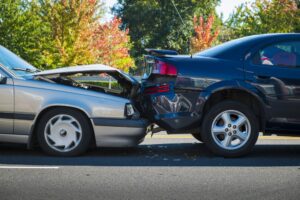 Rear impact crashes are among the most frequent collision types reported throughout Wake County. According to NHTSA crash data, rear end collisions account for approximately 29 percent of all crashes nationally, producing hundreds of thousands of injuries each year. The NHTSA Traffic Safety Facts series consistently identifies rear end crashes as a leading contributor to motor vehicle injuries.
Distracted driving is the single most frequently cited contributing factor in rear impact crashes. NHTSA distracted driving data documents thousands of fatalities and hundreds of thousands of injuries annually resulting from collisions in which driver inattention played a role. Mobile device use remains among the most common forms of distraction reported across North Carolina.
Following too closely is another frequently cited factor. NCDOT crash data consistently identifies tailgating and inadequate following distance as leading causes of reportable crashes in the state. North Carolina records more than 275,000 reportable crashes statewide each year, with rear impacts representing a substantial portion of the total.
CDC transportation safety data continues to identify motor vehicle crashes as a leading cause of death for individuals under 55, with more than 40,000 traffic fatalities reported nationally each year. Rear impact crashes account for a meaningful share of these serious and fatal outcomes.
Speed is also a persistent factor. NHTSA data on speeding attributes roughly 29 percent of all traffic fatalities to speed related causes. In rear impact scenarios, reduced reaction time caused by excessive speed frequently transforms what might have been a minor incident into a serious injury event.
Whiplash and associated cervical injuries remain among the most commonly reported outcomes of rear impact collisions. Research documented by the National Institutes of Health demonstrates that even low speed rear impacts can produce persistent soft tissue injuries requiring extended medical care.
Raleigh Rear End Collision Lawyer FAQs
How much does it cost to hire a Raleigh rear end collision lawyer?
Our firm represents clients on a contingency fee basis. Attorney fees are paid only if a recovery is obtained on the client’s behalf. If no recovery is made, no fee is owed.
Is the consultation truly free?
Yes. The initial case evaluation is provided at no charge and carries no obligation to retain the firm.
Is the rear driver always at fault in a rear end collision?
Not always. Although the trailing driver is presumptively at fault in most rear impact scenarios under North Carolina law, exceptions exist. These may include sudden unsignaled lane changes, malfunctioning brake lights, or other circumstances in which the lead driver contributed to the incident.
How long do I have to file a claim in North Carolina?
Most personal injury claims arising from a rear end collision must be filed within three years of the date of the crash. Wrongful death claims are subject to a two-year limitations period.
What if the other driver has no insurance?
Uninsured motorist coverage on the injured party’s own policy may provide compensation. Even where an individual has been injured by an uninsured driver, a viable claim may still exist against available coverage.
What if I had a preexisting back or neck condition?
Pre-existing conditions do not bar recovery. North Carolina applies the eggshell plaintiff doctrine, which provides that a defendant takes the plaintiff as found. Aggravation of a preexisting condition is a compensable injury, and our firm documents such claims through medical records and provider testimony.
How long will my rear end collision case take?
Most matters resolve within 6 to 18 months. Cases involving surgical intervention, disputed causation, or formal litigation may require additional time to reach resolution.
Must my case proceed to trial?
The majority of cases resolve through negotiated settlement. Our firm prepares each matter as though it will proceed to trial, which generally produces stronger settlement positions at earlier phases.
What is my rear end collision case worth?
Valuation depends on the nature and severity of the injuries, the course of medical treatment, lost income, liability determinations, and available insurance coverage. Our firm addresses the value of a claim during the initial consultation once relevant records have been reviewed.
Who pays my medical expenses while the case is pending?
Health insurance, MedPay coverage, and personal out of pocket funds typically cover medical expenses during the pendency of the claim. Our firm assists in coordinating payment and reimbursement from settlement proceeds where applicable.
Should I give a recorded statement to the other driver’s insurer?
Recorded statements should not be provided without first consulting legal counsel. Such statements are routinely used by adjusters to minimize claim valuations.
What if I was also partly at fault?
Under North Carolina’s pure contributory negligence rule, any degree of fault attributed to the injured party may bar recovery. Claimants should not concede fault based on preliminary statements from insurance adjusters. Our firm will evaluate the available evidence before any such determination is reached.
What should I do first after a crash?
Contact emergency services, obtain medical evaluation, and document the scene. Our firm reviews first steps following a crash with every new client during the initial consultation.
Can the insurance adjuster dispute my injuries if the damage to my vehicle was minor?
Yes. Adjusters frequently attempt to correlate property damage severity with injury severity through what is commonly referred to as the minor impact soft tissue defense. However, research consistently demonstrates that significant injuries may occur even in low property damage crashes.
Does your firm handle cases outside of Raleigh?
Yes. Our firm represents clients throughout Wake County and across North Carolina, including Cary, Holly Springs, Apex, Wake Forest, Chapel Hill, and Knightdale.
Most Dangerous Locations for Rear End Collisions in Raleigh
 Certain Raleigh roadways consistently report higher rear impact crash volumes than others. Congestion, abrupt speed changes, and heavy merging activity all contribute. The corridors our firm regularly investigates include the following:
- I-40 near the I-440 and US-1/US-64 interchanges. Complex merge patterns and frequent traffic slowdowns produce high rear impact volume, particularly during peak commuting hours.
- I-440 Beltline. Ongoing construction activity and variable lane configurations contribute to sustained rear end crash frequency.
- Capital Boulevard (US-1 Business). Frequent signal changes, heavy commercial traffic, and abrupt speed transitions create conditions conducive to rear impact crashes.
- Glenwood Avenue (US-70). Signalized intersections with heavy turning volume regularly produce rear end collisions, particularly during rush hour periods.
- Six Forks Road. Multiple signalized intersections and significant commercial activity generate consistent rear impact claim volume.
- Wade Avenue. Limited merge distances and abrupt slowdowns near the I-440 interchange contribute to rear end crashes.
- US-70 (Glenwood Avenue corridor). Combined commuter and commercial traffic produces frequent signal-related rear impact events.
What Are Important Local Resources for Raleigh Rear End Collisions?
Following a rear impact crash in Raleigh, injured parties may need to contact local agencies and medical facilities. The resources below are frequently useful to clients addressing the aftermath of a collision.
- Raleigh Police Department, (919) 996-3335. Crash report requests and accident documentation.
- Wake County Sheriff’s Office, (919) 856-6900. Investigations within unincorporated portions of the county.
- North Carolina State Highway Patrol, (919) 733-7952. Primary responding agency for interstate collisions.
- WakeMed Raleigh Campus, (919) 350-8000. Level I trauma center.
- Duke Raleigh Hospital, (919) 954-3000.
- UNC REX Healthcare, (919) 784-3100.
- North Carolina Division of Motor Vehicles, (919) 715-7000. Driving records and crash report requests.
- Wake County Clerk of Superior Court, (919) 792-4200.
Disclaimer: Burton Law Firm does not endorse and is not affiliated with any of the resources listed above. The foregoing information is provided solely for reference purposes.
Contact Burton Law Firm
Individuals injured in a rear end collision in the Raleigh area are encouraged to contact our firm for a case evaluation. Consultations are provided at no cost, and no attorney fees are owed unless a recovery is obtained on the client’s behalf.
Prospective clients may submit an inquiry through our website with a description of the crash, the opposing driver’s insurance information if known, and the treating medical facilities. Contact us to discuss representation with a Raleigh rear end collision attorney.