

If you have been injured in a motorcycle crash in Raleigh, you are likely facing medical expenses, lost income, a damaged motorcycle, and an insurance carrier that has already begun building a defense. The decisions made in the days following a collision shape the outcome of the claim that follows.
Motorcycle Accident Lawyer Raleigh, NC
Burton Law Firm represents injured riders throughout Wake County. Attorney Jason Burton brings 13 years of trial experience and has recovered millions of dollars for personal injury clients in North Carolina and Virginia. We understand how insurance carriers evaluate motorcycle claims and how to respond to the tactics they employ against riders.
Our Raleigh, NC motorcycle accident lawyer handles these cases on a contingency basis. No fees are owed unless we recover on your behalf.
Why Choose Burton Law Firm for Motorcycle Accidents in Raleigh, NC?
Knowledge of North Carolina Motorcycle Law
Attorney Jason Burton has practiced injury law in North Carolina since 2013. He is licensed in both North Carolina and Virginia and is a summa cum laude, valedictorian graduate of Elon University School of Law, where he serves on the Advisory Board. Mr. Burton maintains an Avvo rating of 10.0. He has been recognized as a Rising Star by North Carolina Super Lawyers, named Top 10 Under 40 by The National Trial Lawyers, and accepted into the Million Dollar Advocates Forum.
Our personal injury lawyer in Raleigh, NC has devoted his career to plaintiff-side representation in catastrophic injury, motor vehicle, and wrongful death matters. That focus is particularly relevant in motorcycle cases, where insurance carriers often arrive with a predetermined narrative regarding the rider’s conduct.
A Record of Substantial Recoveries
Our firm has obtained millions of dollars on behalf of clients in motor vehicle, motorcycle, and catastrophic injury claims. That record includes a seven-figure motorcycle accident recovery along with multiple six- and seven-figure settlements for seriously injured clients.
Contingency Representation
Clients pay nothing out of pocket. There is no retainer and no hourly billing. Our fee is calculated as a percentage of the recovery, and it applies only if a recovery is obtained. Initial consultations are provided without charge.
Candid Case Evaluation
Not every collision warrants litigation. We provide an honest assessment of case value, identify the issues most likely to be contested, and advise whether a carrier’s offer reflects the reasonable range for similar matters. Clients frequently cite that directness as a reason they return for subsequent matters or refer others.
Motorcycle-Focused Preparation
A motorcycle file is not a car-accident file with a different vehicle involved. Injury severity is typically greater. Liability disputes follow different patterns. Bias against riders is a documented reality in claim valuations and jury deliberations. We begin every motorcycle case with that framework in mind. From the initial intake, we secure the crash report, request 911 audio, arrange preservation of the motorcycle for inspection, and issue evidence-preservation letters to parties that may possess relevant data. Delay measured in weeks can result in the loss of intersection camera footage and similar evidence.
Client Feedback
⭐⭐⭐⭐⭐
“Jason was such a pleasure to work with! He is very professional, detail oriented, and caring! He is very thoughtful and treats you with a genuine kindness that is hard to come by these days. I am very grateful I chose Jason Burton to represent me in a car accident claim! He is by far the best and do not hesitate to use his services if you want the best of the best!” -Maryn Reichart
Additional reviews are available on our Google Business Profile.
Types of Motorcycle Accident Cases We Handle in Raleigh
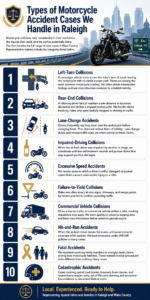
Motorcycle collisions vary considerably in their mechanics, the injuries that result, and the parties potentially liable. Our firm handles the full range of rider cases in Wake County. Representative matters include the categories listed below.
- Left-turn collisions. A passenger vehicle turns across the rider’s lane of travel, leaving the motorcycle with no viable escape path. These cases are among the most common motorcycle collisions and typically place liability on the turning driver. We frequently obtain intersection camera footage and engage reconstructionists to establish approach speeds.
- Rear-end collisions. A following driver fails to maintain a safe distance or becomes distracted and strikes a stopped motorcyclist. Our firm handles rear-end collision claims involving riders who were lawfully stopped or decelerating in traffic.
- Lane-change accidents. Drivers who change lanes without confirming their surroundings frequently state that they never saw the motorcycle. That admission does not relieve them of liability. Lane-splitting laws and lane-change duties are specifically addressed under North Carolina law.
- Impaired-driving collisions. When the at-fault driver was impaired by alcohol or drugs, we coordinate with law enforcement records and pursue DUI accident claims that may support an award of punitive damages.
- Excessive speed accidents. Our firm handles speeding accident cases in which a driver’s willful disregard of posted limits resulted in catastrophic injury to a rider.
- Failure-to-yield collisions. Riders are frequently struck at stop signs, driveways, and merge points by drivers who failed to confirm oncoming traffic.
- Commercial vehicle collisions. When a tractor-trailer or commercial vehicle strikes a rider, federal trucking regulations may apply. We coordinate with our truck accident lawyer files to preserve electronic logging data and black-box information before retention periods expire.
- Hit-and-run accidents. When the at-fault driver leaves the scene, uninsured-motorist coverage generally applies. We have recovered under UM/UIM policies in numerous matters.
- Fatal accidents. Our firm represents surviving family members in wrongful death claims arising from motorcycle fatalities. These matters involve procedural requirements distinct from ordinary injury cases.
- Catastrophic accidents. Matters involving spinal cord injuries, traumatic brain injuries, and severe burns require early engagement of life-care planners and vocational economists to document lifetime costs.
Raleigh Motorcycle Accident Infographic
North Carolina Legal Requirements for Motorcycle Accidents
 Several provisions of North Carolina law govern motorcycle claims and warrant early attention.
Statute of limitations. Under N.C. Gen. Stat. § 1-52, an injured party generally has three years from the date of the collision to file a personal injury action. Wrongful death claims are governed by N.C. Gen. Stat. § 1-53 and must be filed within two years. A claim filed after the applicable period is barred, regardless of its underlying merit. The text of these provisions is available through the North Carolina General Assembly.
Helmet requirement. North Carolina requires all motorcycle operators and passengers to wear a DOT-approved helmet at all times. The statute appears at N.C. Gen. Stat. § 20-140.4. The NCDOT motorcycle page summarizes the licensing and equipment requirements in accessible language.
Pure contributory negligence. North Carolina remains one of the few jurisdictions to apply pure contributory negligence. If a jury finds the rider bears any degree of fault, even one percent, the rider is barred from recovery. Insurance adjusters are familiar with this doctrine and routinely invoke it. Our firm prepares cases with the anticipation of such arguments.
Insurance coverage requirements. Motorcyclists are subject to the same minimum liability insurance obligations as other drivers, currently 30/60/25. Uninsured- and underinsured-motorist coverage is required on North Carolina auto policies under N.C. Gen. Stat. § 20-279.21. UM/UIM coverage often represents the most substantial source of recovery in motorcycle cases where the at-fault driver carries only minimum limits.
What Damages Are Recoverable in Raleigh Motorcycle Accident Cases?
North Carolina law recognizes three primary categories of damages available to a motorcycle crash victim. Each requires specific documentation and proof.
Economic Damages
Economic damages are those that can be quantified through documentation and calculation. They include:
- Past and future medical expenses, including emergency services, surgical care, rehabilitation, imaging, pharmaceuticals, and durable medical equipment
- Lost wages and diminished earning capacity. Where a rider can no longer perform the physical requirements of prior employment, we retain vocational economists to quantify the long-term impact
- Property damage to the motorcycle, helmet, and protective equipment
- Incidental expenses related to medical treatment, home modifications, and in-home care
Non-Economic Damages
Non-economic damages compensate losses that resist precise calculation. These often represent the most significant component of a serious case.
- Pain and suffering
- Mental anguish and post-traumatic stress, which frequently follow motorcycle collisions
- Permanent disfigurement and scarring
- Loss of enjoyment of life
- Loss of consortium, a claim belonging to a spouse
Some riders initially underestimate the value of these categories. Carriers typically do the same. Our firm substantiates non-economic damages through medical records, treating provider testimony, mental health treatment notes, photographs, and day-in-the-life documentation.
Punitive Damages
Under N.C. Gen. Stat. § 1D-15, a jury may award punitive damages when the defendant’s conduct was willful or wanton. Conduct supporting such awards may include driving while impaired, street racing, and high-speed fleeing from law enforcement. Punitive damages in North Carolina are capped at three times compensatory damages or $250,000, whichever is greater.
Wrongful Death Damages
In cases involving the loss of a family member, the estate may recover funeral and final medical expenses, lost net income, and the value of the decedent’s care, companionship, and guidance pursuant to N.C. Gen. Stat. § 28A-18-2. These claims are filed by the personal representative of the estate, not by individual family members. Our firm assists families with the appointment of a personal representative where necessary.
Documentation of each type of damages category begins on intake. Carriers look for evidentiary gaps to reduce valuation, and we prepare the file accordingly.
What Steps Should I Take After a Motorcycle Accident?
The following ten actions, taken in the immediate aftermath of a crash, protect both the rider’s health and the integrity of any subsequent claim.
- Move to a position of safety. If movement is possible without risk of aggravating injuries, relocate away from the roadway. Secondary collisions at crash scenes occur with some frequency.
- Contact 911. Request emergency medical services and law enforcement, even if injuries appear minor. The resulting crash report serves as foundational evidence. Raleigh Police Department or the North Carolina State Highway Patrol will respond depending on jurisdiction.
- Accept medical evaluation at the scene. Adrenaline often masks the symptoms of serious injury. Head, neck, and spinal trauma frequently do not manifest for several hours.
- Refrain from apologies or speculative statements. Any statement made at the scene may be admissible in subsequent proceedings. Communications should be limited to factual observations.
- Photograph the scene in detail. Document the motorcycle, involved vehicles, skid marks, debris fields, protective equipment, visible injuries, and roadway conditions. Thorough documentation assists reconstruction.
- Obtain witness information. Secure contact information from every witness present. Witness availability diminishes quickly after the day of the collision.
- Preserve protective equipment. Helmets, jackets, boots, and other gear should not be discarded. Damage patterns provide evidence of impact forces.
- Seek prompt medical follow-up. An emergency department or urgent care visit on the day of the crash, followed by primary care review within the week, establishes the medical record. Treatment gaps frequently become the basis for adjuster arguments.
- Limit social media activity. Insurance investigators routinely review claimants’ public social media content. Photographs unrelated to the injury may nonetheless be used to challenge damages claims.
- Consult a motorcycle accident lawyer before communicating with the carrier. Statements made to the at-fault driver’s insurer can be used to reduce or deny the claim.
The first 72 hours after a crash carry disproportionate weight in the ultimate outcome of a claim. Evidence preservation, medical documentation, and the management of communications with insurers establish the framework for everything that follows.
Motorcycle Accident Statistics in Raleigh
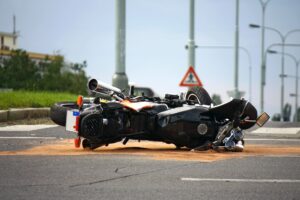 The data regarding motorcycle crashes in North Carolina is sobering, and Wake County accounts for a meaningful share.
According to NHTSA crash data, 6,218 motorcyclists died nationwide in 2022, the highest figure on record. Motorcyclists are approximately 24 times more likely to die in a crash per vehicle mile traveled than passenger vehicle occupants and four times more likely to sustain injury, according to NHTSA traffic safety facts.
In North Carolina, the NCDOT Traffic Safety Unit reports more than 3,500 motorcycle-involved collisions annually, resulting in approximately 180 to 220 fatalities each year. The NCDOT Highway Safety Program compiles and publishes annual reports reflecting these figures.
Wake County, which encompasses Raleigh, consistently ranks among the top five counties in North Carolina for total motor vehicle collisions according to the NCDOT crash data tool. With a population exceeding 1.1 million and substantial commuter traffic on I-40, I-440, I-540, and US-1, Wake County produces hundreds of motorcycle injuries each year.
Additional data provides context:
- Approximately 80 percent of motorcycle collisions result in injury or death, compared to roughly 20 percent of passenger vehicle crashes, according to the CDC.
- Head trauma remains the leading cause of motorcycle fatalities. Helmets reduce the risk of fatal injury by approximately 37 percent, according to CDC helmet research.
- Intersections account for nearly 40 percent of motorcycle crashes, with left-turning vehicles representing the largest contributing factor, according to the Insurance Institute for Highway Safety.
- Alcohol impairment is a factor in approximately one in four fatal motorcycle collisions nationally.
These figures are significant because insurance carriers frequently invoke generalized statistics regarding motorcycle risk without addressing the specific facts of a given crash. Our firm uses the same body of data to establish what a reasonable driver should have anticipated and done.
Raleigh Motorcycle Accident Lawyer FAQs
How much does it cost to hire a Raleigh motorcycle accident lawyer?
Nothing at the outset. Our firm handles motorcycle cases on contingency. The fee is calculated as a percentage of the recovery and is payable only if a recovery is obtained.
How long do I have to file a motorcycle accident claim in North Carolina?
Three years from the date of the crash for personal injury under N.C. Gen. Stat. § 1-52. Two years for wrongful death. Exceptions apply for minors and for claims asserted against government entities, which involve substantially shorter notice periods.
Does wearing a helmet affect my claim?
It can. North Carolina requires helmet use by all operators and passengers. Riding without a DOT-approved helmet may be raised as a basis for contributory negligence.
The at-fault driver carries only minimum insurance. Do I have options?
In most cases, yes. Your own auto policy may include underinsured-motorist coverage, which can provide additional recovery beyond the tortfeasor’s limits. Our firm reviews all applicable coverages at the outset.
What if the driver fled the scene?
Uninsured-motorist coverage generally applies in hit-and-run cases. The claim proceeds through the injured rider’s own carrier, although the process remains adversarial.
Am I required to give a recorded statement to the insurance company?
No, and we generally advise against providing such statements, particularly to the at-fault driver’s carrier. Clients should consult counsel before any such communication.
The carrier has already offered a settlement. Should I accept?
Early offers commonly fail to reflect the full value of injuries that develop over time. Once a release is signed, the claim is resolved. We recommend consulting counsel before accepting any offer.
What if I was partially at fault?
North Carolina applies pure contributory negligence. Even a small finding of fault against the rider can bar recovery entirely. Our firm builds the file to anticipate and respond to fault-shifting arguments.
How is pain and suffering calculated?
No mathematical formula applies. Jurors consider the nature and duration of medical treatment, permanency of injury, and the effect of the injuries on the rider’s daily life.
How long will my case take?
Matters with clear liability and limited injuries may resolve within several months. Cases involving surgery, disputed liability, or litigation typically require a year or more. We do not pursue premature settlements for the firm’s convenience.
Can I recover lost wages if I am self-employed?
Yes, with appropriate documentation. Tax returns, 1099 forms, profit-and-loss statements, and executed contracts all assist in establishing lost income.
My family member died in a motorcycle crash. What recovery is available?
A wrongful death action is initiated by the personal representative of the decedent’s estate. Recoverable damages include funeral expenses, lost income, and the value of the decedent’s care and companionship.
Will my case go to trial?
Most motorcycle matters resolve through negotiation. Some proceed to trial. Mr. Burton is a trial lawyer, and defendants consider that fact when evaluating our files.
Does motorcycle bias influence case outcomes?
It can. Jurors, adjusters, and in some instances investigating officers bring assumptions to motorcycle matters. Our firm addresses this through case narrative and, where necessary, through voir dire.
What should I bring to an initial consultation?
The crash report, photographs, the applicable insurance policies, all correspondence with carriers, and a list of treating providers. Clients lacking any of the above should still schedule a consultation, as our firm can assist in obtaining missing items.
Most Dangerous Locations for Motorcycle Accidents in Raleigh
 Certain corridors in Raleigh appear repeatedly in crash reporting. While riders cannot avoid all of them, awareness of the patterns is useful.
- Capital Boulevard (US-1). High volume, high speeds, and frequent intersection collisions. Multiple fatal motorcycle crashes have occurred along this corridor over the past decade.
- Interstate 40 through Raleigh. Substantial commercial traffic and heavy interchange activity. Several fatal motorcycle crashes have been reported on I-40 near S. Saunders Street.
- Interstate 440 (Beltline). Curved segments near Wade Avenue, frequent lane changes, and persistent rush-hour congestion contribute to rider risk.
- Interstate 540. Speed-related and lane-change collisions involving motorcycles.
- New Bern Avenue. Intersection collisions and significant pedestrian activity.
- Glenwood Avenue. Mixed-use corridor with turn-conflict exposure.
- Falls of Neuse Road. Curve geometry and driveway conflicts have produced multiple rider injuries.
- Six Forks Road. Commuter volume and intersection exposure.
NCDOT safety data reflects these corridors as continuing areas of concern. Our firm has handled motorcycle collisions on substantially all of them.
What Are Important Local Resources for Raleigh Motorcycle Accidents?
The resources below may be of assistance following a motorcycle crash in the Raleigh area. Burton Law Firm is not affiliated with any of these organizations. Their inclusion is not an endorsement.
- Raleigh Police Department. Main line: (919) 996-3335. Handles non-emergency traffic collision reporting and provides crash report copies.
- Wake County Sheriff’s Office. Main line: (919) 856-6900. Responds to collisions in unincorporated areas of Wake County.
- North Carolina State Highway Patrol. Troop C main line: (919) 733-7952. Investigates collisions on interstates and state highways.
- WakeMed Trauma Center. Main line: (919) 350-8000. Level I trauma facility serving Wake County and surrounding counties.
- UNC Health Rex. Main line: (919) 784-3100. Major Raleigh hospital system.
- Duke Raleigh Hospital. Main line: (919) 954-3000. Provides trauma and orthopedic care.
- NCDOT Crash Reports. Portal for ordering official crash report copies.
Contact Burton Law Firm
Motorcycle claims proceed quickly. Physical evidence deteriorates. Witness recollections fade. Insurance carriers begin constructing their defense before the injured rider is released from the hospital.
Burton Law Firm accepts Raleigh motorcycle accident cases on contingency. No fees are owed unless a recovery is obtained. The initial consultation is provided at no charge. During that consultation, we will review the circumstances of the crash, address your questions directly, and provide our assessment of the matter.
Contact us to discuss your motorcycle accident case with our firm.
Visit Our Raleigh Motorcycle Accident Lawyers.
219 N Boylan Ave 1st Floor, Raleigh, NC 27603