

Wrongful Death Lawyer Raleigh, NC
If your family has lost someone in a preventable incident in Raleigh, you are facing a combination of grief, financial strain, and procedural questions that feel impossible to sort through in the weeks after a death. Funeral expenses arrive quickly. Insurance adjusters begin contacting the family. And the first steps in a wrongful death case often have to be taken while the household is still adjusting to the loss.
Burton Law Firm represents families throughout Wake County in claims arising from the loss of a loved one. Attorney Jason Burton has 13 years of experience in catastrophic injury and wrongful death matters and has recovered millions of dollars for clients in North Carolina and Virginia. We understand the procedural requirements that govern these cases in North Carolina and the evidentiary work required to prove the value of a life.
Our Raleigh, NC wrongful death lawyer handles these matters on contingency. No fees are owed unless we recover on the family’s behalf.
Why Choose Burton Law Firm for Wrongful Death in Raleigh, NC?
Choosing counsel during a period of mourning is an unusual task. The considerations below are intended to assist families evaluating their options.
Experience With Catastrophic and Fatal Injury Claims
Attorney Jason Burton has practiced plaintiff-side injury law since 2013. He is licensed in North Carolina and Virginia and is a summa cum laude, valedictorian graduate of Elon University School of Law, where he serves on the Advisory Board. Mr. Burton maintains an Avvo rating of 10.0 and has been recognized by North Carolina Super Lawyers as a Rising Star, by the National Trial Lawyers as a Top 10 Under 40, and by the Multi-Million Dollar Advocates Forum.
Our personal injury lawyer in Raleigh, NC concentrates on catastrophic injury, motor vehicle, and wrongful death matters. Fatal injury claims sit at the core of that practice.
A Record of Substantial Recoveries
Our firm has obtained millions of dollars for clients in motor vehicle, premises liability, and wrongful death matters, including seven-figure wrongful death recoveries.
Contingency Representation
Families pay nothing upfront. There is no retainer and no hourly billing. Our fee is calculated as a percentage of the recovery and applies only when we recover. The initial consultation is provided at no charge.
Coordination With the Estate
A wrongful death claim is brought by the personal representative of the decedent’s estate, not by individual family members. Our firm assists families with the Clerk of Court appointment process when a personal representative has not yet been named, and we coordinate with any existing estate counsel to move the claim forward without disrupting probate administration.
Measured and Respectful Communication
Families of the deceased often carry the weight of practical decisions during a period of profound grief. We keep communication direct, timely, and proportional to what the family asks for. Some clients want frequent updates. Others prefer minimal contact. We adapt to the family’s preferences.
Client Feedback
⭐⭐⭐⭐⭐
“Jason Burton was very knowledgeable and took the time to answer all my questions clearly. He explained how denied insurance claims can still be challenged, the difference between medical negligence and complications, and how systemic factors can impact care. I appreciated that he was honest, compassionate, and focused not only on results but also on fairness and justice. Highly recommend Burton Law Firm!” – Karon Hopkins
Additional reviews are available on our Google Business Profile.
Types of Wrongful Death Cases We Handle in Raleigh
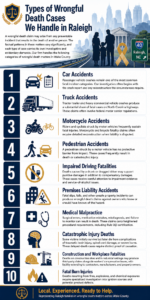
 A wrongful death claim may arise from any preventable incident that results in the death of another person. The factual patterns in wrongful death matters vary significantly, and each type of case carries its own investigative and evidentiary demands. Our firm handles the following categories of wrongful death matters in Wake County.
- Car accidents. Passenger vehicle crashes remain one of the most common fatal incident categories, and our investigation often begins with the crash report alongside any car accident reconstruction the circumstances require.
- Truck accidents. Tractor-trailer and heavy commercial vehicle crashes produce a substantial share of fatal injury cases on North Carolina highways, and truck accident claims involve federal motor carrier regulations that shape liability.
- Motorcycle accidents. Riders and cyclists struck by motor vehicles frequently sustain fatal injuries, and motorcycle accident matters and bicycle collision claims often require reconstruction when liability is disputed.
- Pedestrian accidents. A pedestrian struck by a motor vehicle has no protective barrier between the body and the impact, and pedestrian accident cases frequently end in death or catastrophic injury.
- Impaired driving fatalities. Deaths caused by a drunk or drugged driver may support punitive damages in addition to compensatory damages, and DUI accident claims receive particular attention to the impaired driver’s prior conduct and the conduct of any establishment that served alcohol.
- Premises liability accidents. Fatal slips, falls, and other premises liability incidents arising from unsafe property conditions produce wrongful death claims against owners who knew or should have known of the hazard.
- Medical malpractice. Surgical errors, medication errors, misdiagnosis of stroke or heart attack, and failure to monitor can result in death, and medical malpractice wrongful death claims carry heightened procedural requirements including Rule 9(j) certification.
- Catastrophic injury deaths. A victim who initially survives may later die from complications of traumatic brain injury, spinal cord damage, or severe burns, and those delayed-death cases involve distinct proof of causation.
- Construction and workplace fatalities. Deaths on construction sites and in industrial settings may produce third-party claims alongside any workers’ compensation recovery, with liability extending to general contractors, equipment manufacturers, and property owners.
- Fatal burn injuries. Deaths resulting from burn injuries in fires, explosions, and chemical exposures involve specialized investigation of ignition sources and product defects.
North Carolina Legal Requirements for Wrongful Death
North Carolina law sets specific rules for who may bring a wrongful death action, when it must be filed, and what damages are recoverable. Several provisions warrant early attention.
Statute of limitations. Under N.C. Gen. Stat. § 1-53, a wrongful death action must be filed within two years of the date of death. This period is shorter than the three-year window that applies to most personal injury claims under § 1-52, and it cannot be extended by the length of time the decedent survived after the incident. The text of these provisions is available through the North Carolina General Assembly.
Who may bring the action. The wrongful death statute, N.C. Gen. Stat. § 28A-18-2, provides that the claim must be brought by the personal representative of the decedent’s estate. Individual family members do not have standing to sue in their own names, although they may ultimately receive distribution from the recovery. Appointment of a personal representative is handled by the Clerk of Superior Court in the county of the decedent’s residence.
Distribution of recovery. Recovery in a wrongful death action is distributed according to the North Carolina Intestate Succession Act under N.C. Gen. Stat. Chapter 29, regardless of whether the decedent left a will. The statutory formula determines which family members receive what share, which can produce outcomes that differ from a decedent’s stated wishes.
Medical malpractice modifications. Claims alleging a medical provider caused the death are subject to additional requirements. A Rule 9(j) certification of qualified medical review must accompany the complaint, and additional limitations apply under N.C. Gen. Stat. § 90-21.19 to non-economic damages in professional liability matters.
Pure contributory negligence. North Carolina applies pure contributory negligence, a doctrine that can bar recovery entirely if the decedent bore any portion of fault. The rule is a recurring issue in motor vehicle cases, and the claim file must be built to foreclose fault-shifting arguments.
Claims against government entities. If a government entity or employee caused the death, shorter notice periods apply, and recovery may be capped by the State Tort Claims Act or by local government immunity provisions. Early consultation is essential when a public entity may be involved.
What Damages Are Recoverable in Raleigh Wrongful Death Cases?
North Carolina law recognizes several categories of damages in a wrongful death action under N.C. Gen. Stat. § 28A-18-2, including financial damages for the death of a loved one. The recovery belongs to the estate, subject to statutory distribution.
Economic Damages
Economic damages are those capable of documentation and calculation.
- Medical expenses incurred between the injury and death
- Funeral and burial expenses
- Lost net income the decedent would have earned, calculated using earning capacity, career trajectory, and life expectancy
- The monetary value of services, protection, care, and assistance the decedent provided to the family
- Present monetary value of the decedent’s future earnings
Quantification of lost income and services in a wrongful death case typically requires vocational and economic consultants, and our firm retains these professionals early when the case warrants it.
Non-Economic Damages
Non-economic damages compensate the family for losses that resist precise calculation.
- Loss of the decedent’s society, companionship, comfort, and guidance
- Loss of parental consortium for minor children
- Loss of spousal consortium
- The pain and suffering of the decedent during any period of conscious survival after the injury
Careful documentation of the relationships the decedent maintained, the role the decedent played in the household, and the specific losses each family member experienced supports these damages at negotiation and trial.
Punitive Damages
Under N.C. Gen. Stat. § 1D-15, a jury may award punitive damages when the defendant’s conduct was willful or wanton. Drunk driving that causes death, gross corporate negligence, and reckless disregard for human life may each support such awards. Punitive damages are capped at three times compensatory damages or $250,000, whichever is greater. An exception lifts the cap in cases where the death resulted from driving while impaired. The North Carolina punitive damages statute is published by the General Assembly.
Interest and Costs
Recovery also includes statutory interest from the date of filing and court costs in appropriate cases.
What Steps Should I Take After a Wrongful Death?
The following ten steps, taken in the days and weeks after a family member’s death, protect both the grieving family and the integrity of any subsequent claim. In most cases, a surviving spouse, adult child, or other close family member will handle these tasks.
- Obtain certified copies of the death certificate. Multiple certified copies will be needed for estate administration, insurance claims, and the wrongful death action. The North Carolina Division of Public Health issues certificates through its vital records office.
- Preserve evidence from the incident. Accident reports, medical records, photographs, witness information, and any physical evidence should be collected and kept safe. Do not discard the decedent’s belongings from the incident, including damaged clothing or personal effects.
- Secure medical and autopsy records. If an autopsy was performed, the report is often central to proving causation. Hospital records, emergency department notes, and treating provider records should all be requested.
- Limit communication with insurance carriers. Adjusters may contact the family quickly. Do not provide recorded statements, sign releases, or accept offers without consulting counsel.
- Identify all applicable insurance coverage. Auto liability, underinsured motorist, umbrella, homeowners, commercial general liability, and workers’ compensation policies may all apply depending on the circumstances of the death.
- Consult with a wrongful death attorney promptly. The two-year statute of limitations is shorter than most families realize, and evidence begins degrading immediately.
- Begin the estate appointment process. The Clerk of Superior Court in the county of the decedent’s residence handles appointment of a personal representative. The claim cannot proceed until a representative has qualified.
- Document financial impact on the household. Lost wages, loss of benefits, loss of household services, and increased caregiving responsibilities should be tracked from the outset.
- Preserve digital records. Emails, text messages, social media posts, and phone records related to the incident or the decedent’s final days should be secured before they are lost.
- Attend to the family’s emotional needs. Practical steps matter, but so does bereavement support. Counseling, grief groups, and the resources of faith communities play an important role during this period.
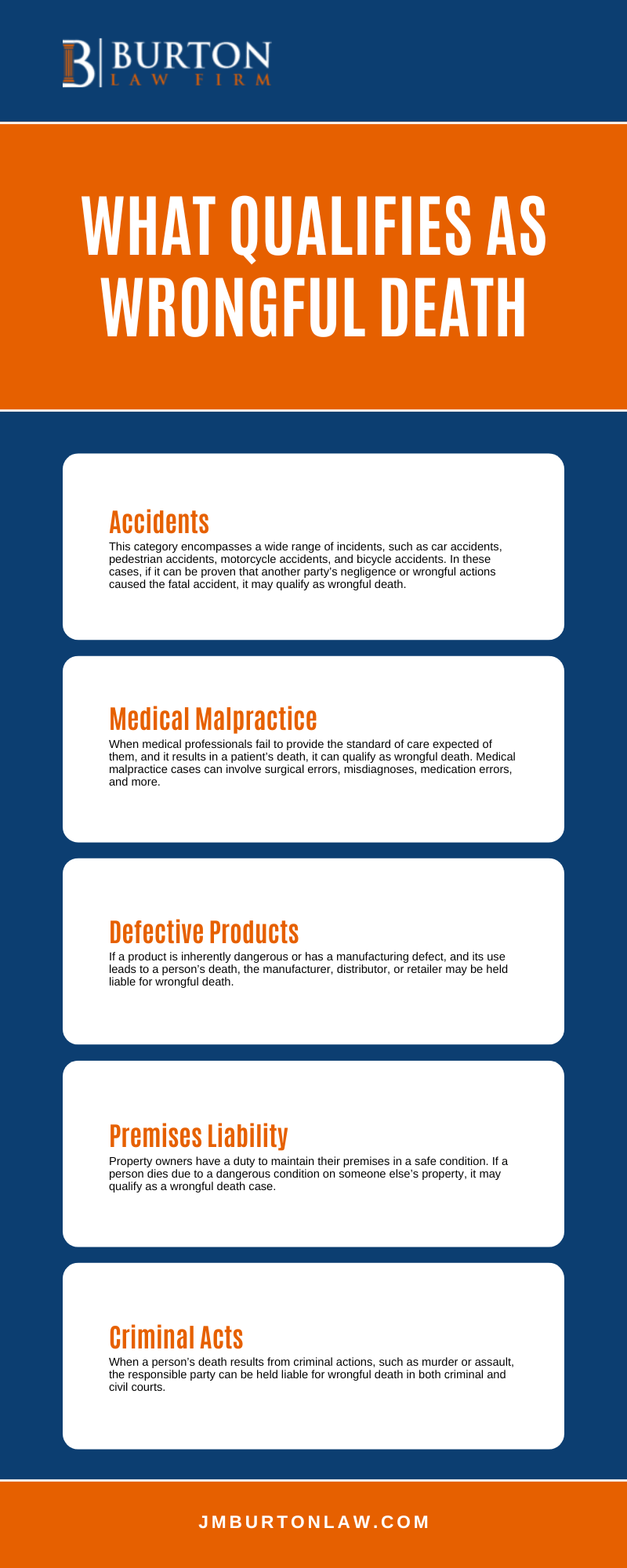
Raleigh Wrongful Death Infographic
Wrongful Death Statistics in Raleigh
Preventable deaths remain a persistent source of loss in North Carolina. The underlying data provides context for how these cases are understood and investigated.
According to the Centers for Disease Control and Prevention, unintentional injury is consistently among the leading causes of death in the United States, with motor vehicle crashes, falls, and poisoning accounting for a large share of preventable fatalities. The CDC’s WISQARS data system publishes detailed statistics on injury-related deaths by state and county.
The National Highway Traffic Safety Administration tracks fatal motor vehicle crash data and publishes annual reports. In recent years, traffic fatalities in the United States have risen, with increases in pedestrian, motorcyclist, and commercial vehicle fatalities contributing to the overall trend.
In North Carolina, the NCDOT Highway Safety Program reports annual figures reflecting traffic fatalities on state roadways, and the NCDOT crash data tool provides county-level detail.
Wake County, with a population exceeding 1.1 million and significant commuter traffic on I-40, I-440, I-540, and US-1, experiences a meaningful share of the state’s traffic fatalities each year. WakeMed operates a Level I Trauma Center serving the region, and the concentration of trauma care at WakeMed shapes both the medical record and the evidentiary posture of the cases that follow.
Medical malpractice fatalities are more difficult to quantify because they are not consistently reported in public datasets, but research cited by the Agency for Healthcare Research and Quality indicates that medical error contributes to a substantial number of preventable deaths nationally each year.
Defense counsel sometimes invoke broad statistics to argue that a particular death was unavoidable or that the decedent bore responsibility. Those generalizations do not determine individual cases, and our firm focuses on the specific facts, documents, and witnesses that establish the cause of a particular death.
Raleigh Wrongful Death Lawyer FAQs
How much does it cost to hire a Raleigh wrongful death lawyer?
Nothing at the outset. Our firm handles wrongful death cases on contingency. The fee is calculated as a percentage of the recovery and is payable only if a recovery is obtained.
How long do I have to file a wrongful death claim in North Carolina?
Two years from the date of death under N.C. Gen. Stat. § 1-53. This period is strict and is not extended by the time the decedent survived after the incident. Shorter notice periods apply to claims against government entities.
Who can bring a wrongful death claim?
The personal representative of the decedent’s estate, appointed by the Clerk of Superior Court. Despite common misconceptions about wrongful death claims, individual family members cannot sue in their own names, although they may receive distribution from any recovery.
How is the recovery distributed among family members?
According to North Carolina’s Intestate Succession Act. The statutory formula applies regardless of whether the decedent left a will, and it determines which family members receive what share.
What if the decedent was partially at fault?
North Carolina’s pure contributory negligence doctrine can bar recovery if the decedent bore any portion of fault. Our firm builds cases to foreclose fault-shifting arguments from the carrier.
Can I recover if my loved one had a preexisting condition?
Yes, in most cases. North Carolina applies the eggshell plaintiff rule, which holds a defendant responsible for the full extent of harm caused, even if the decedent was more vulnerable than an average person. Causation analysis still matters, and the treating record is central.
What if my loved one died in a hospital?
Medical malpractice wrongful death claims are among the most procedurally demanding. A Rule 9(j) certification of qualified medical review must accompany the complaint, and specific statutory modifications apply under N.C. Gen. Stat. § 90-21.19.
What if the death occurred at work?
Workplace deaths often produce workers’ compensation claims alongside third-party wrongful death actions. Workers’ compensation is the exclusive remedy against the employer in most cases, but claims may proceed against equipment manufacturers, subcontractors, and property owners.
Can punitive damages apply in a wrongful death case?
Yes, when the conduct was willful or wanton. Drunk driving deaths and grossly reckless conduct are common examples. The statutory cap on punitive damages does not apply to deaths caused by driving while impaired.
How long does a wrongful death case take?
Cases with clear liability and limited contest may resolve in several months. Cases involving litigation, medical malpractice, or disputed causation commonly require one to three years. We do not pursue premature settlements that undervalue a life.
Will the case need to go to trial?
Most wrongful death cases resolve through negotiation or mediation. Some proceed to trial. Mr. Burton is a trial attorney, and that capability factors into carrier evaluations of our cases.
Does the estate need to complete probate before filing?
No. The appointment of a personal representative is required before filing the wrongful death action, but full administration of the estate does not need to be complete. The wrongful death recovery is not subject to the claims of the decedent’s creditors, with limited exceptions.
How are wrongful death damages proven?
Through medical records, autopsy reports, employment records, tax returns, family testimony, photographs, and qualified witnesses including economists and vocational consultants. The quality of the damages proof often determines the ultimate recovery.
What should I avoid doing?
Avoid speaking to the other party’s insurer without counsel. Avoid posting about the incident or the decedent on social media. Avoid signing any release or accepting any payment before understanding the value of the case.
What should I bring to an initial consultation?
The death certificate, any accident or incident reports, medical records you have received, insurance information, the will if one exists, and any correspondence from insurers or attorneys. Families lacking these items should still schedule a consultation. Our firm can assist with record gathering.
What to Expect With Your Wrongful Death Case
Wrongful death cases do not follow a uniform timeline. Several factors most affect the process, including the complexity of liability, the availability of insurance coverage, the need for professional testimony on damages, and whether the defense engages in meaningful pre-suit negotiation.
The first weeks of representation focus on evidence preservation, estate coordination, and the assembly of medical, financial, and relational documentation. Our firm works closely with treating providers, law enforcement, and, when the facts warrant, reconstruction consultants.
As the factual record is developed, we prepare a demand package that establishes liability and quantifies damages with professional support. The carrier’s response frequently reflects a valuation substantially below the case worth. Negotiation follows.
When pre-suit negotiation does not produce a fair resolution, we file suit on behalf of the personal representative. Litigation involves discovery, depositions, mediation, and, in cases that do not settle, trial. Each stage is conducted with attention to the family’s preferences regarding involvement, testimony, and communication.
What Are Important Local Resources for Raleigh + Wrongful Death?
The resources below may be of assistance to families following the loss of a loved one in the Raleigh area. Burton Law Firm is not affiliated with any of these organizations, and inclusion is not an endorsement.
- Wake County Clerk of Superior Court. Main line: (919) 792-4000. Handles appointment of the personal representative of an estate.
- North Carolina Vital Records. Division of Public Health office for ordering certified copies of death certificates.
- Wake County Medical Examiner. Investigates deaths under the jurisdiction of the Office of the Chief Medical Examiner.
- WakeMed. Main line: (919) 350-8000. Level I trauma facility where many Wake County fatal injury cases receive care.
- Transitions LifeCare. Main line: (919) 828-0890. Hospice and grief counseling services for Wake County families.
- Hospice of Wake County bereavement services. Bereavement and grief support for surviving family members.
- NCDOT Traffic Fatality Reports. Information on traffic fatality data and safety initiatives in North Carolina.
Contact Burton Law Firm
Wrongful death cases require both legal rigor and respect for what the family is going through. We handle both.
Burton Law Firm accepts Raleigh wrongful death cases on contingency. No fees are owed unless a recovery is obtained. The initial consultation is provided at no charge, and we can meet with families at a location and time that work for them.
Contact us to discuss your family’s case with our firm.