
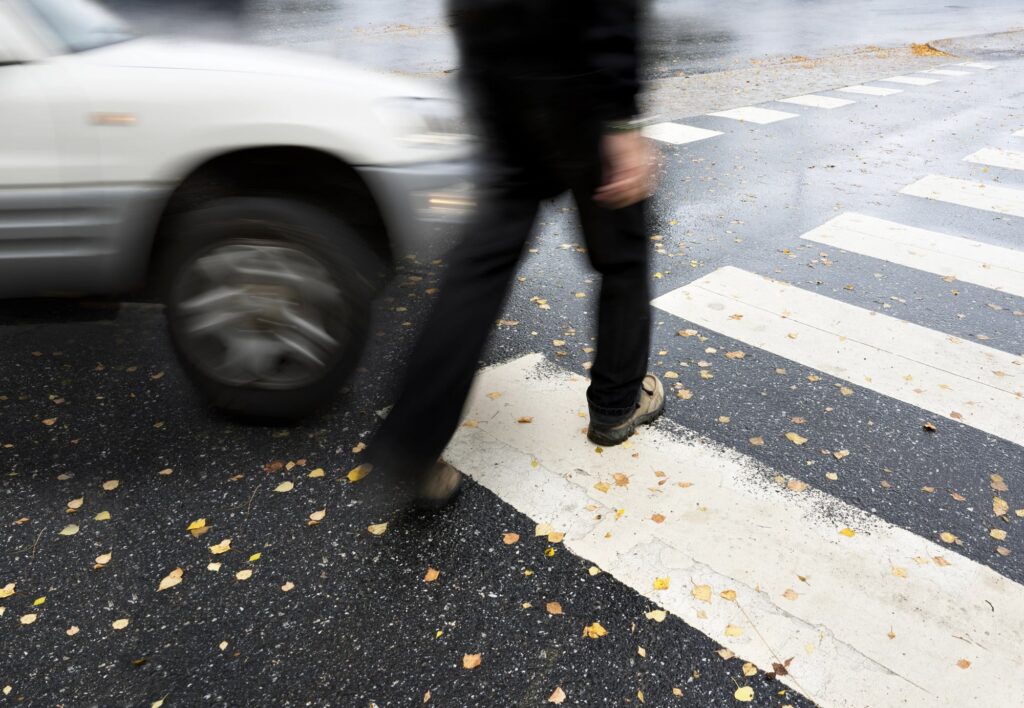
A marked crosswalk gives a person on foot more than a painted stripe. North Carolina law tells drivers when they must yield to someone crossing and when they may not pass a car that has already stopped. Those rules shape fault after a pedestrian crash.
Drivers must yield at crosswalks without signals
North Carolina General Statutes Section 20-173 requires a driver to give way to a person on foot crossing within a marked crosswalk, or within an unmarked crosswalk at or near an intersection, when traffic signals are absent or not operating. The driver must slow down or stop if necessary. The duty is subject to other rules in Part 11 of the same article.
The rule applies where no working signal controls the crossing. A pedestrian crossing at a dark intersection is covered, so the status of the signal becomes an early question in any claim.
Passing a stopped car near a crosswalk is barred
When a vehicle stops at a marked crosswalk, or at an unmarked crosswalk at an intersection, to let someone cross, a driver approaching from behind may not pass it. Where the first car stopped is therefore a fact to document.
Anyone hurt after a driver passed a stopped car can ask a Raleigh pedestrian accident lawyer how the order of events fits this rule. The driver who stopped is a witness to the pass.
Driveways and walkways carry a separate duty
The statute adds a third rule. A driver crossing a sidewalk to enter or leave a driveway or other private access must yield to pedestrians and bicyclists approaching on a sidewalk or walkway that crosses the opening.
A driver watching for gaps in road traffic can miss a person on the sidewalk, and the statute names bicyclists as well as pedestrians. Photos of the end of the driveway and the sidewalk show whether the walkway was visible from the driver’s seat.
Evidence that sorts out a crosswalk crash
Evidence that settles disputed facts includes the following:
- Signal timing records can show whether the light was working.
- Camera video from nearby businesses can capture the stop and the pass.
- Photos of the markings can show whether a crosswalk was visible.
- Phone records can show whether a driver was distracted.
When the driver leaves, the search for the vehicle begins, and a hit-and-run claim leans on nearby cameras. Business footage may be overwritten.
Early statements can weaken a claim
Pedestrians who leave the scene by ambulance may say little to anyone. A short remark to an officer or adjuster can still be repeated later.
Apologies and casual remarks about fault are the kind of early claim mistakes that can be used against an injured person later. Sticking to the facts with the officer and the adjuster is the safer course.
Insurers may blame the pedestrian for where the crossing happened
Insurers may argue that the pedestrian crossed at the wrong spot or stepped out suddenly. Those arguments are answered with facts about the signal, the markings, and the driver’s speed.
Jason Michael Burton comes from five generations of trial lawyers and is licensed in North Carolina and Virginia. He has practiced for 13 years in catastrophic injury and motor vehicle cases at Burton Law Firm, our firm, and he holds a law degree from Elon University School of Law.
Impaired drivers add evidence
Some pedestrian crashes involve drivers who were impaired. Blood test results, arrest records, and officer observations then become part of the file.
In one reported case, a jury awarded punitive damages after hearing evidence that a driver was intoxicated when she struck a pedestrian crossing the street, and the Court of Appeals upheld the award. Impairment evidence was part of what the jury heard.
Body camera footage and lab results should be requested early. Those records matter in a DUI crash case because they speak to conduct as well as to fault.
Fatal crashes and what follows
A crash that ends in a death brings the family questions about funeral costs and who may file a claim. Those questions are separate from the fault issues covered above.
Families who lose a loved one may pursue a wrongful death claim, and the crosswalk rules above still apply to the question of fault. The same scene evidence supports both kinds of case.
Because signal records and camera footage come from outside sources, a family dealing with a crosswalk crash may want to reach out to a Raleigh pedestrian accident lawyer early. Notes on the signal phase and the walking route belong in the starting file.